
Using Props in Your Practice
Meg Fyfe Watkins | NOV 29, 2022
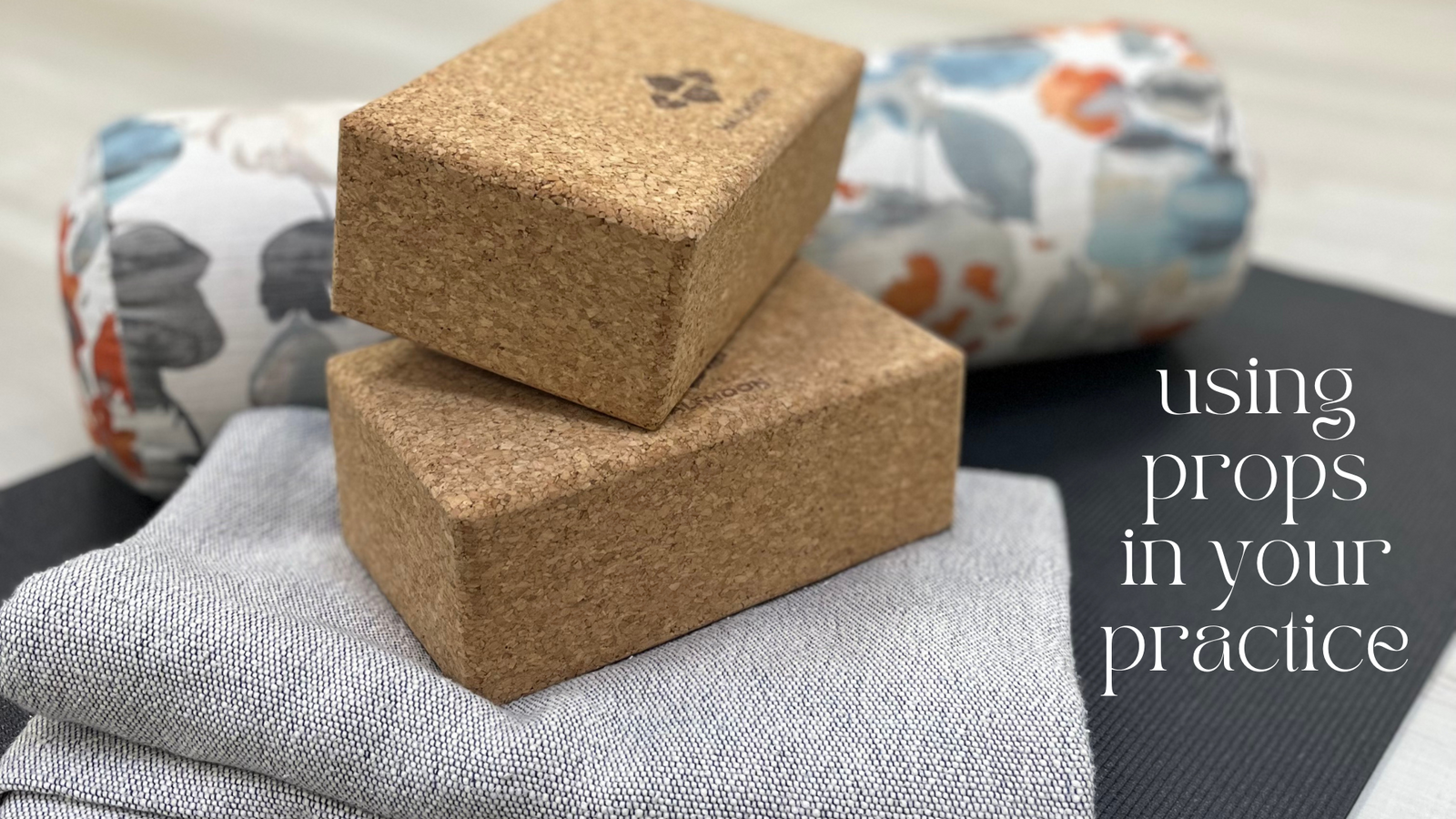
One of the best ways to make yoga accessible for everyone is with the use of props. At Kind Community Yoga, we have many props which are available for everyone to use. If you've been following us on Facebook or Instagram, you may have seen some posts we shared about using props in your yoga practice (they are still there if you want to check!)
In this article, we share more information about how to incorporate yoga props into your yoga classes.
Blocks
The blocks we have are cork blocks and they can be used in three heights. One of the main uses for blocks are to place our hands on when we can't reach the ground. Some examples of this are in half split, low lunge, or pyramid where you could place the blocks on either side of your front foot and rest your hands on the blocks.
Keep in mind that we all have different skeletal systems. So, although you may notice your flexibility change after a regular yoga practice, the proportions and orientation of your skeleton will not change. So for example, if you have a longer torso in relation to your arms, it will be harder for your hands to touch the ground in the above mentioned shapes (half split, low lunge, pyramid).
Similarly, having a block on the inner edge of your front foot in triangle and placing your hand on the block can allow you the opportunity to focus on keeping length in both sides of your torso and keeping your chest broad, rather than trying to touch the floor (that's not the goal!)
Blocks can also be used for support, for example in child's pose or pigeon, if your forehead does not touch the ground you could rest it on a bolster instead. Or in the squat position, if it doesn't feel good on your knees or ankles, you could place a few blocks between your feet and sit on them.
Bolsters
One of the most common ways of using a bolster is placing it under the knees when lying on the back in shavasana. Many people feel discomfort in their lower backs when they lie down flat, but if you allow the knees to be supported by the bolster it might feel better.
The bolster can also be used under the knees while doing seated forward folds. Especially for those with tight hamstrings, this can be helpful to allow you to fold forward easier.
There are many ways to sit on bolsters. For example, if when sitting in a cross legged position your knees are higher than your hips, try sitting up on the bolster, with your legs crossed on the ground in front of you. Or, when sitting in thunderbolt pose, instead of sitting on your heels, you can place the bolster between your legs and sit on it instead.
Like the block, the bolster can also be used to rest your head or chest on when doing postures like child's pose, pigeon, or animal relaxation pose.
Another great way to use the bolster is for a supine chest opening pose. Lie with your back on the bolster and hips and legs on the mat in front of you, then allow your arms to relax down on either side of the bolster.
Blankets
Blankets can of course be used as blankets. If you feel cold in shavasana or any yin posture, feel free to cover yourself with a blanket.
Blankets provide great padding. For example, if your knee hurts when you place it on the ground in a low lunge or half-split position, try placing a blanket on your mat, then resting the knee on the blanket. Some people feel discomfort in their hip bones or pelvic area when lying on their front for back bends such as cobra, locust, or bow. You can place the blanket under your torso for support.
Sitting on a folded blanket will raise the hips slightly, which is helpful for any seated forward fold position.
The blanket can also be used as a pillow in shavasana or any other supine position, or it can be used to support the hips in pigeon pose.
Straps
Straps are mostly used to help reach things. For example, in a seated forward fold, you could wrap the strap around your feet and hold either end of the strap, which may help you keep length in your spine and stretch in the back of the legs.
In the pictures you can see a few other ways to use a strap for supine leg stretches and the gomukasana arms.
Chairs
Chairs are an incredibly useful and versatile prop to have in your yoga practice. Almost any standing pose can be done with a chair which can help you focus on good alignment and breathing. Chairs can be helpful for balancing poses.
Many poses that are normally done on the floor can also be done on the chair, if getting up and down off the floor is challenging.
You are welcome to grab any prop, including a chair, and place it beside your yoga mat when you come into the studio. The teachers will give lots of options on how to use the props, but you can also feel free to add them in, even if the teacher doesn't mention it.
What we have shared here is just the tip of the iceberg of how props can be used to help your yoga practice. We hope this will inspire you to experiment on your own, or come in to some of our classes to let our experienced teachers show you how the props can be useful.
Meg Fyfe Watkins | NOV 29, 2022
Share this blog post